Which Sony Cameras Are The Best And Which One To Buy
Canon holds the spot for the dying DSLR camera market entry level cameras. 48% of all interchangeable lens systems.
Sony holds only 14% of the total market but their revenue is higher than that of canon coz they focus on full frame high end premium products.
If reading is boring for you, then just go ahead and watch this
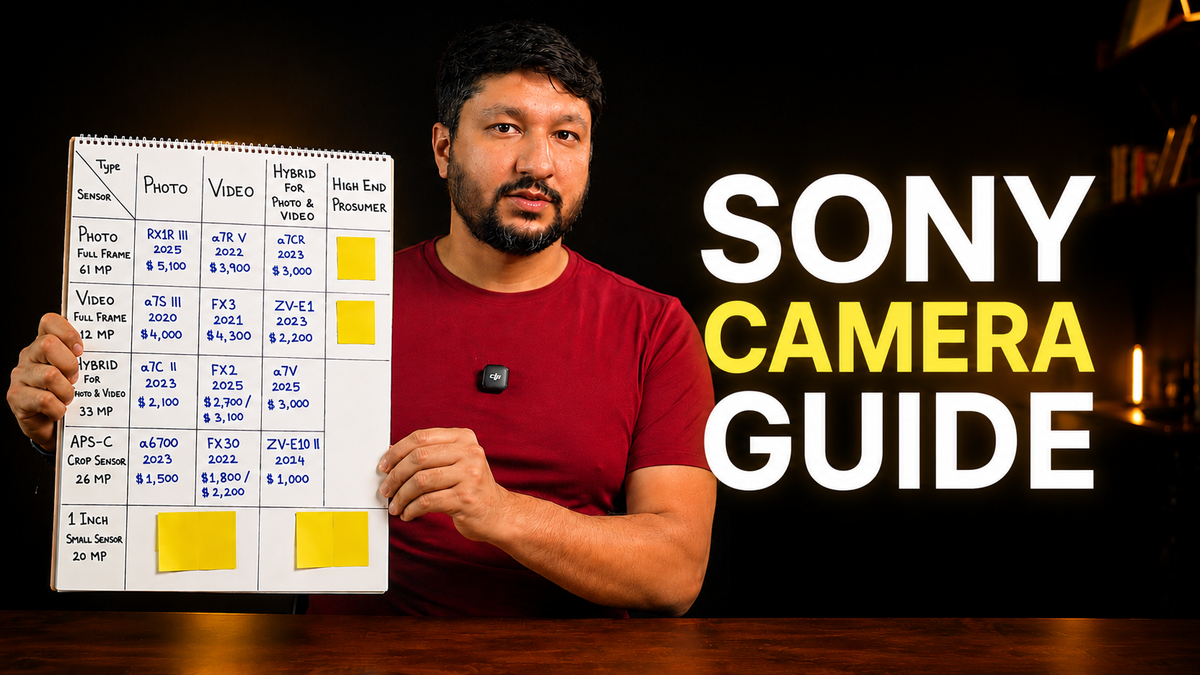
Lets take the FX3, which was released in 2021 and is still widely used because Sony got several things right simultaneously:
- Excellent low-light performance from its 12MP full-frame sensor
- Very low rolling shutter for its class
- Reliable autofocus
- Strong thermal management
- Compact cinema-focused body
- Mature color science (especially S-Cinetone)
- Deep integration with Sony's lens ecosystem
Competitors often match one or two of those areas but not all of them together.
For example:
- Panasonic Lumix s1ii and S1Rii offer excellent codecs and video features, but Panasonic's autofocus reputation took years to recover from its contrast-detect era and it heats up
- Nikon ZR the cinema line joke with micro SD. Nikon's video ecosystem and accessory ecosystem remain smaller.
- Canon EOS C50 technically impressive, but Canon's lens strategy and ecosystem limitations are still debated by some creators.
Sony's recent moves are interesting
Sony's addition of 32-bit float audio support through the new Sony XLR-A4 XLR Adapter is a meaningful upgrade for solo shooters and documentary filmmakers.
That's the kind of workflow-focused improvement that doesn't look exciting on a spec sheet but matters on set.
The partially and fully stacked sensor strategy
Sony appears to be expanding the use of partially stacked sensors.
The recently announced
- Sony A7 V uses a new 33MP partially stacked sensor and
- a7R VI with 66.8MP fully‑stacked
giving much faster readout speeds and improved blackout-free shooting compared with previous generations.
A partially stacked sensor is essentially a middle ground between:
- Traditional BSI sensors
- Fully stacked flagship sensors such as those used in high-end sports cameras
The advantage is that Sony can deliver much of the speed benefit without pushing prices into flagship territory.
The bigger picture
Sony's advantage today is not just color science.
What makes Sony difficult to challenge is the combination of:
- Sensor technology leadership
- Autofocus performance
- Cinema workflow features and ladder the climb in cameras
- Lens ecosystem depth
- Third-party support
- Reliable thermal performance
- It's own screen in TVs
- It's mics and headphones
Many competitors equal Sony in one category, and some exceed Sony in specific areas. But very few currently offer the same overall package that made Sony successful.